
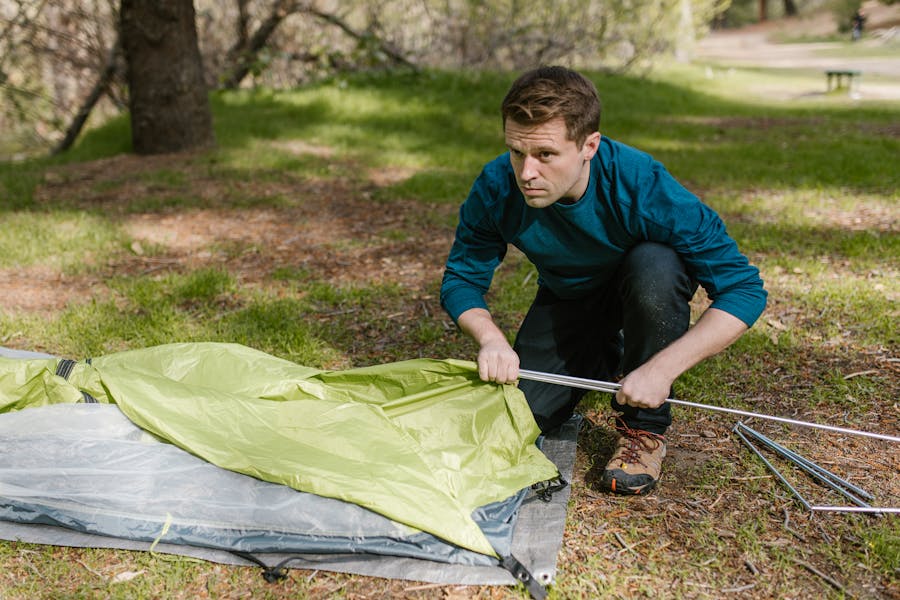
A poorly staked tent can be a massive fault when camping. If you are stressed about getting it done right away, here we’ve got you covered. We bring you the complete beginner’s guide on how to stake a tent correctly, along with tips against different types of grounds and seasonal aspects.
Let’s get started with,
- Steps to stake a tent correctly
- The significance of staking a tent correctly
- Stake a tent on sandy ground
- Stake a tent on snow or frozen ground
- Stake a tent on gravel
- How to stake a tent in windy settings
- How to take a tent on concrete
Staking a tent isn’t always easy and can be challenging due to various ground conditions. The tent is the shelter where you camp and is of utmost importance to have a properly staked tent to offer the protection you required. To ensure no trouble happens to take off fun, go through the guide.
Steps to stake a tent correctly
- Walk around for some minutes and choose the perfect site
As you are going to sleep on the ground when camping consider whether the ground is rocky, has tree roots, or is on a level. At the same time, consider what is above and around the selected spot.
- Tie the guy lines
Make sure you tie the guy lines at the same time staking the base of the tent. With this, you can maximize the interior space of the tent with its correct structure.
- Set the corner guy lines at an angle
Guy lines at 45 angles allow pulling the line offers the maximum area inside also helping with waterproofing even if the wind picks up.
Tip: Pack extra stakes to be more prepared for unexpected weather conditions
- Straight up stake
Drive a stake straight down into the territory for extreme penetration and fight well against severe wind conditions.
Tip: Use a hammer to drive the stake in. Alternatively, you can use a rock, the back of the axe, and backpackers can use the hatchet. But never use your foot or hand
- If insecure, use more stakes
There are different types of stakes and be intelligent to choose the right stakes. Among them, 7″ Aluminum Tent Stakes, 12″ Aluminum Tent Stakes (For Sand or Snow), and 11″ Galvanized Steel Stakes are among the most popular. Have different types of stakes to rightly handle any change in the ground.
- Helpful hooks
There is a reason why there is a small hook at the end of the stake. That comes in handy by providing extra tension to your guy rope in opposition to the soil.
When the hook faces outside your tent, it is safeguarded by the soil. There, take it as a backup anchor.
Tip: To set up your tent properly, bring lockable, double-sided carabiners helping to connect the loop on the stake with the guy line on the tent. And these are much helpful in stringing the tarp above the fire and also the tent.
Additional support: Makeshift stakes are additional anchors that are easy by tying a rope of the tent to a rock nearby. To keep in the right place, use a larger rock on the top
The significance of staking a tent correctly
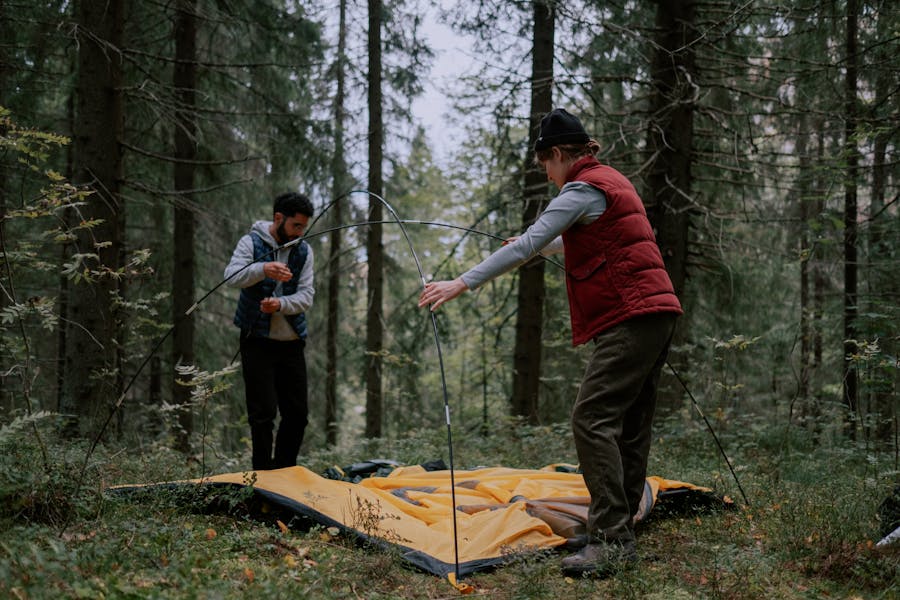
Stakes and pegs are small yet extremely important pieces of gear when it comes to staking a tent correctly in the backcountry. Including them correct in number and order, you have to stake your tent in the right way for a number of reasons. Here we bring you the importance of staking out your tent correctly as follows.
To efficiently block the wind
For increased wind resistance, your tent staking should have been done in the right way. With a well-staked tent, you can withstand winds while a poorly staked tent would easily flap around.
Improved waterproofing
Anchoring your camping tent properly can benefit by improving the waterproofing facilities. By staking right, it separates the rainfly from the tent’s internal body. It stops water from leaking into the inner space when you are facing an unexpected rainstorm.
Enhance the durability
If the tent flaps around wind conditions, there is a big chance for it to get ripped. So, if you stake the rainfly correctly and set the tent properly, you can minimize the chance of damages and can use it longer.
Stake a tent on sandy ground
If you are planning your trip to sandy grounds like Joshua Tree National Park, Death Valley, or any it would be different from staking a tent on firm ground. In the sandy ground, more consideration goes with having the stakes right in the place throughout the time. So, invest in quality sand stakes to prevent battling throughout the night. The sand stake has a larger surface area compared with other tent pegs.
- Stake with a slight spiral arrangement for the locations having packed sand
- In loose sandy grounds take longer stakes that are about 10” to 12” long and consider broader width
- Set up the stake upright into the soil for extra holding support
- To make your stakes position right switch them out for large rocks and anchor
Stake a tent on snow or frozen ground
When staking out tents in winter, snow, and frozen grounds are common troubles with relative challenges. Compared with sandy, the ground covered with snow involves too much work. In fact, you will require plenty of wide and large stakes for staking out your tent in firm snow just as used for sandy soils. But if you are going where there is loose snow where stakes do not work, you will have to change the plans. In fact, you will have to swap to the Deadman system for pitching your tent in a particular environment.
Deadman anchoring system involves numerous sturdy items like sticks, and a shovel to dig out holes in snow as where you would do to position the stakes. And before burying the sticks in snow, tie each stick with the guy lines. Then you can bury the anchors properly by putting snow on the top and stamping. With all these, you can make your tent survive in severe weather.
If you are going to Glacier National Park-like destination where there would be frozen grounds, the best is where you invest in a quality set of titanium/ steel nail-style stakes. They can easily pitch even with rock making it easier to pitch your tent on frozen grounds.
Stake a tent on gravel
We can commonly find large, gravel-filled tent pads to pitch shelters for campers which becomes quite challenging in staking your tent properly even it works best in the perspective of erosion management. But you can still manage with normal tent stakes in these grounds as they work well in gravelly terrain.
- Have a hammer or any similar tool to place tent stakes, alternatively, a solid rock can work too
- For extra holding strength, you need to support stakes with larger rocks or log on the top of each that are positioned in loose gravel
How to stake a tent in windy settings
The windy climate is an obvious challenge for campers and badly impacts staking out a tent. Wind can be strong and harmful to rip your stakes. If you are going to camp somewhere like Great Smoky Mountains National Park where the wind forecast can be worse, you have to know the staking tactics correctly to survive against the severe weather.
The main thing here about staking your tent properly in windy locations is all on reinforcing the stakes to the well as possible. You can support the stakes with solid objects or can anchor to stronger structures like trees. The important thing here is providing extra holding power when wind rules around.
- Proper stake orientation with J-shaped stakes featuring a big hook at the top
- The hook should surface opposite the tent to keep the guy lines in the right position
How to take a tent on concrete
It is a challenge to stake a tent on the concrete and come as a unique thing to manage where you cannot use stakes as the anchors like other ground conditions. Here on the solid concrete ground, there is only a little tent peg can do. So here you have to be a little smarter to do the job. Make your own anchor points and protect the tent on the concrete.
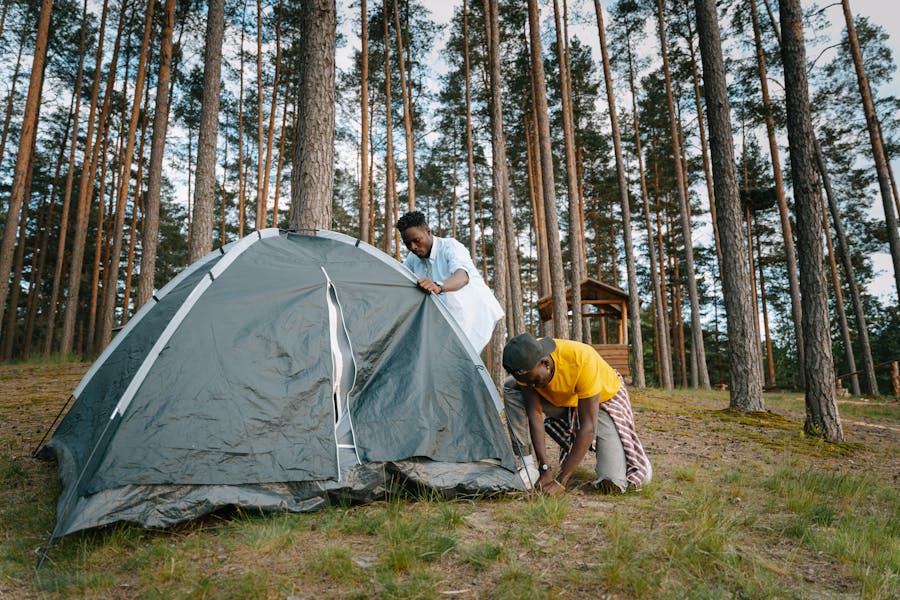
To make anchor points use the large rocks and logs from your area. But in case there are no suitable rocks or your tent is larger, you can form makeshift anchor points on your own. For that, use some strong 5-gallon buckets filled with pebbles or something similar to weigh down the buckets. Then you can connect the guy lines to them just as you do with usual tent stakes.
Your tent is your home away from home when camping! Stake up correctly and enjoy!
Read More: