

If you’ve ever gone hiking, specifically in a changing climate, you know how important your footwear selection is. Unfortunately, many casual hikers assume that their usual footwear will suffice on the route, only to discover that this is not the case. Hiking boots or hiking shoes are required for any terrain that is not entirely level, groomed, or manicured. So, when it comes to Hiking Shoes vs. Boots? Which option is the best?
It isn’t easy to know what is best in Hiking Shoes vs. Boots, better for your outdoor experiences. Even though hiking boots and shoes appear pretty similar, they each have benefits and drawbacks. This article will compare hiking shoes with hiking boots to help you decide which is best for you.
What is a hiking boot?
Hiking boots are high-top shoes with thick outsoles designed primarily for usage in challenging terrain and are the typical footwear choice for outdoor adventure. Hiking boots have been popular for centuries. However, in the years following WWI, the high-top leather hiking boot style took shape.
Hiking boots have a long and illustrious history in the outdoors. However, hiking boot design and style have changed significantly over time. Modern versions can be pretty lightweight and flexible, whereas the classic boot was a high-top full-leather shoe with a heavy outsole. The purpose is to keep your feet safe at all costs and return home with all of your toes unharmed. The fabric was thick and heavy, with little consideration for comfort or elegance.
Hiking boots, like hiking shoes, excel in a variety of situations. However, some people choose to use them for longer expeditions or in situations when they will be carrying a big backpack, such as a camping trip in Yosemite National Park.
What is a hiking shoe?
Hiking shoes are smoother than hiking boots, require less breaking in, and are easier to fit. Hiking shoes, which resemble tennis shoes in appearance and feel, are a breathable, comfort-focused option for camping trips. They have more robust outsoles than tennis shoes, yet they’re still flexible underfoot. In addition, and are easier to fit.
Hiking shoes have first introduced to the market a few decades ago and have grown in popularity among day hikers and light backpackers in places like Acadia National Park. Although some proponents believe that they are also better in rainy situations than hiking boots, they are suitable for dry weather and gentler terrain. Hiking shoes, they argue, are often composed of a breathable material that dries faster than leather. As a result, your feet will be in better form after a hike.
In truth, there is no one-size-fits-all application for hiking boots, as some models are suitable for a wide range of conditions. Most people, though, find that they’re better suited to shorter travel or situations where they won’t be carrying a lot of weight. But, again, this is because they don’t provide much ankle support or durability.
What’s the difference between hiking boots and shoes?
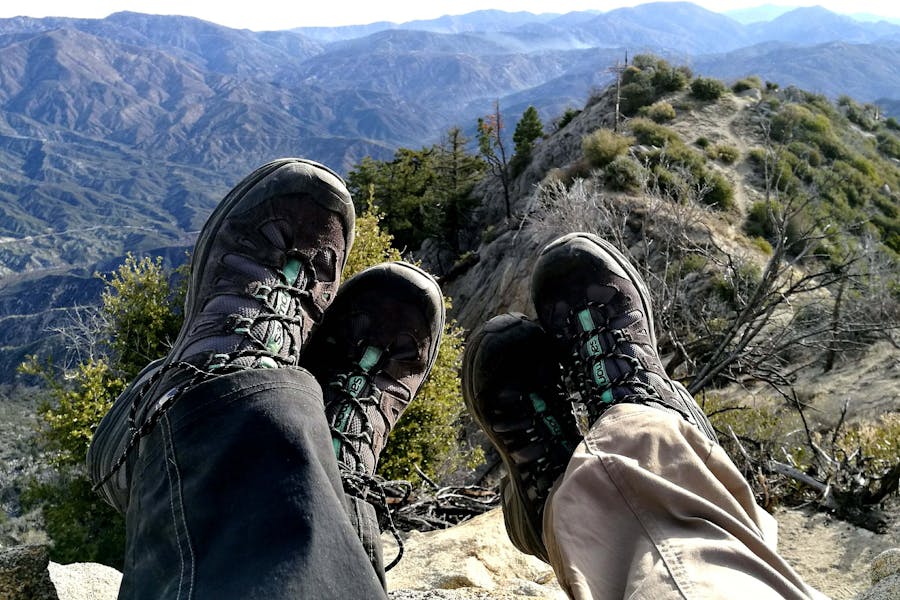
Consider hiking footwear to be a variety. Low-cut and lightweight trail running shoes are on one end of the spectrum, with stiffer bottoms, grippier treads, and a better fit than their road-running counterparts. Heavy-duty, trail-stomping hiking boots with a high ankle collar, robust and durable materials, and a stiff and long-lasting sole are on the spectrum. Hiking shoes, which combine aspects of both boots and trail runners, fall somewhere in the middle. Below we mentioned key features between hiking shoes and hiking boots.
Durability
Nobody wants to spend their hard-earned money on a piece of equipment to have it break down after a few journeys. As a result, having shoes that can survive the rough and tumble environment of the wilderness is essential. In addition, both hiking boots and shoes should be pretty comfortable. After all, unpleasant footwear is useless! However, this isn’t always the case, and comfort levels can vary dramatically between brands and styles of footwear.
If you consider more durable camping shoes, Hiking boots are recommended because they are often built of more durable materials that give better foot and ankle protection. In the case of footwear, the materials used to make the shoe are closely related to its durability. For example, boots and shoes made of leather or synthetic leather are typically more durable than fabrics or mesh.
As a result, hiking boots, often constructed of leather or synthetic leather, are the more durable option. Hiking shoes are frequently made of mesh and fabrics to reduce weight and enhance breathability. On the other hand, shoes made of mesh and fabrics are more susceptible to rip and tear with continuous wear.
Hiking boots made of leather or synthetic leather also offer better protection for your feet and ankles. This is because they are better at shielding you from sticks, pebbles, and other trail detritus than hiking shoes’ fabrics.
Comfort and fit
When it comes to fit and comfort, these two are is totally different. On the other hand, hiking shoes will provide a significantly more comfortable trekking experience.
Hiking shoes are pretty similar to many of us wear every day, contributing to extra comfort. Though most people do not walk about in heavy leather boots daily, many people are used to wearing sneakers and other footwear that is comparable in shape and size to hiking boots. Of course, there are exceptions to any rule, and you will undoubtedly come across some extremely comfy hiking boots. However, hiking shoes are usually the preferred choice for trail comfort when it comes to trail comfort.
The fit of a hiking shoe or boot is the most important feature! The boot should be snug enough to support your foot, especially your heel. It must also provide space around your toes and an area for your feet as they swell. Based on the manufacturer’s design, you may need to order a size larger than your usual shoe size. If you’re shopping online, do your research by looking at the retailer’s sizing charts and online reviews from other customers.
Shoes are easier to fit than leather boots because they’re softer and adapt to your foot more easily. Sizing should be similar to an athletic shoe, with a snug heel, arch support, and sufficient room for your toes.
Roll your ankles from side to side to assess the support when trying on a boot or shoe. Then, walk around the store as long as possible with the boots on to check for any pressure points or pain. Remove them and try another pair or four if they aren’t working. Every hiking boot is unique, intended to fit a variety of foot types; take your time to discover the appropriate pair. When trying on boots, wear the hiking socks you’ll be wearing on the trail.
Ankle support
In contrast to your favorite hiking poles, footwear with enough ankle support is a necessity if you’re worried about injuries on the route. Hiking boots are popular because of their high tops and thick outsoles, which give ample ankle support while walking.
The level of ankle support provided by hiking boots and hiking shoes is the most important difference between them. The uppers of hiking boots are firm and cushioned, and they fasten around the ankle. Hiking shoes, on the other hand, provide relatively minimal ankle support.
Hiking boots give additional ankle support than ordinary hiking shoes because of their high-top structure. Because hiking boots may wrap entirely around your ankle, they work as a natural brace to help you walk more steadily. However, ankle support isn’t exclusively defined by the height of your boots. In addition, when wearing a hefty hiking backpack, boots with firm soles give additional support for your ankles.
Waterproofing
Wet boots and hiking socks are sure to make you feel uncomfortable on the journey. As a result, a pair of waterproof shoes or boots might significantly affect your hiking experience. Most trail campers, hiking shoes, and hiking boots are waterproof, with a Gore-Tex or similar covering impervious to liquid water but enables some sweat vapor to escape. This is useful in rainy and muddy hiking areas such as the Northeast, but the material makes your feet hotter and sweatier in drier places.
Clearly explained, when you step into a puddle or stream, low-top hiking shoes are more likely to fill up with water. In addition, because of its shorter height, water is more easily able to fill in over the top of the shoe. As a result, hiking boots, typically taller, are better at keeping your feet dry when crossing rivers. Although there are exceptions to every rule, high-top boots come out on top when it comes to waterproofing.
Weight
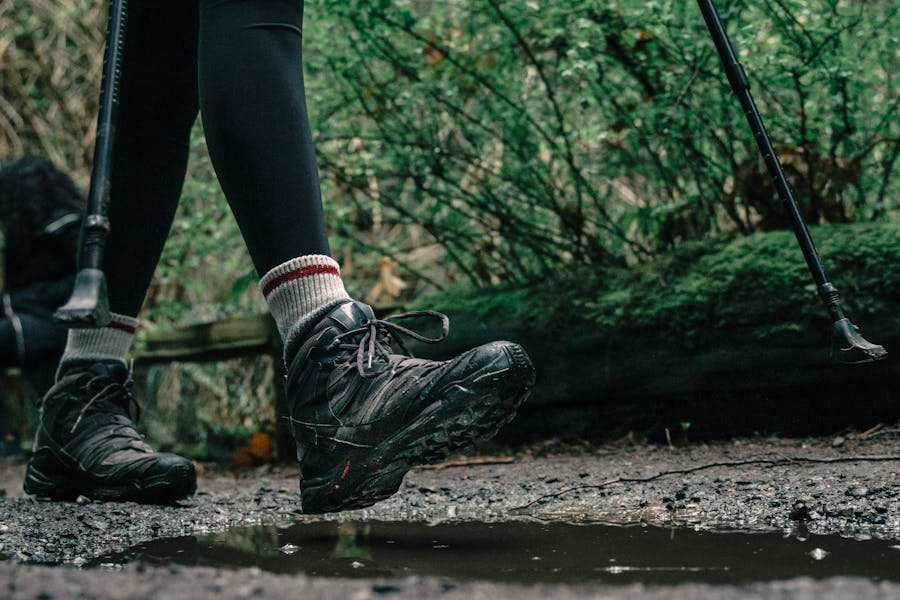
The weight on your feet significantly impacts how much energy you waste during hiking. According to studies, hiking with greater importance on your feet consumes substantially more energy than hiking with the same weight on your back. An ancient saying in the outdoor sector is that 1 pound of weight on your feet equals 5 pounds on your back. While this statement may appear to be exaggerated, it is based on a real study undertaken by the US Army in 1984.
While the study is outdated, the message is still relevant today. Carrying extra weight on your feet puts more strain on your body and requires more energy. So when you plan on doing a lot of trekking, it’s crucial to reduce the amount of weight on your feet.
It’s essential to keep track of how many calories you’re burning on your feet, mainly when covering a lot of ground rapidly with little effort. Trail runners are the clear victor in this section, and they are a trendy choice among long-distance hikers. According to a 2019 Appalachian Trail thru-hikers poll, nearly three-quarters of them hiked in trail runners, while less than ten percent hiked in hiking boots.
Hiking boots, on average, weigh significantly more than hiking shoes. The large outsoles and thick materials utilized to make hiking boots in the first place are to blame for the added weight. On the other hand, hiking shoes are usually far more flexible and light.
Ventilation and breathability
Breathability in footwear is determined by the materials used in its construction. Textiles and mesh, which are thin, highly porous materials, are more breathable than thick leather footwear. They outperform full-leather boots.
Furthermore, most hiking boots have quite high tops doesn’t assist with breathability. However, while hiking in muggy circumstances, you can expect increased ventilation from most hiking shoes because they feature a low-cut shape below your ankle.
Cost
A good pair of trail runners or hiking shoes will set you back anywhere between $100 and $150. Hiking boots, on the other hand, hiking boots can well cost twice as much as that, mainly if they are made of high-quality all-leather. Based on how far you hike, the overall cost over time will differ. When you hike the trails often and hard, a single pair of robust boots will cost less in the long run than numerous pairs of trail runners or hiking shoes.
Finally, while searching for gear, money is always a consideration. With hundreds of hiking shoes and boots to choose from, it’s hard to argue that every hiking boot is more costly than every hiking shoe.
On the other hand, hiking shoes are typically significantly less expensive than their boot-style counterparts. The textiles and mesh fabrics used to produce hiking boots are substantially less expensive than the leather used in hiking boots, which accounts for most of the cost reductions.
You should try on many pairs of shoes to get a good sense of how they fit. However, in these times, you could want to shop online. If this is the case, don’t be afraid to return a pair of ill-fitting shoes. The trouble of returning them will be small compared to having a terrible pair of shoes. Nothing ruins a hike like blistering or sore feet. Hope you have a good understanding of hiking boots and shoes. So this is your turn to explore which one is best for your next camping adventure.
While you should prioritize comfy, supportive footwear when planning a good hike. Hikers and backpackers will spend the majority of their money on footwear. However, getting the right camping gear is also the most challenging choice. You’ll be more likely to pick the ideal decision for your hiking feet and the terrain you hike as you become a hiker.
This article has walked you through Hiking Shoes vs. Boots that process to assist you in deciding which option is best for you. These expert recommendations may help you avoid costly or unpleasant mistakes and maximize the benefits of a hiking boot, hiking shoe, or trail runner. Each one has the potential to be a fantastic option (or a bad choice). It’s simply choosing the right fit for your body and hiking style. Happy journey!
Read more: